



Hematite is often described as a powerful grounding stone. Its connection to the root chakra helps you feel secure and stable in your everyday life. With Hematite, you can enhance your strength, focus, and overall sense of well-being. This metallic mineral, composed primarily of iron oxide, is known for its unique energy that can absorb negative thoughts and feelings, making it a sought-after ally for those seeking balance.

You might be surprised to learn that Hematite is not just beautiful but also functional in daily living. Many people use it to boost confidence and mental clarity. The use of Hematite extends beyond crystal healing; researchers are even exploring its applications in technology through iron oxide nanoparticles. These tiny particles have potential uses in various fields, including medicine and environmental science, showcasing Hematite’s versatility.
So, if you’re looking for a way to bring more strength and stability into your life, consider incorporating Hematite. Whether you wear it as jewelry, place it in your home, or meditate with it, you’ll find that this remarkable stone can help you build a solid foundation for your well-being.
The Basics of Hematite
Try a free zodiac tool
Read today’s message for your sign
Get a fresh zodiac forecast for timing, relationships, and reflection.
Hematite is a fascinating stone known for its grounding properties and unique qualities. Let’s explore what hematite is, its role in semiconductors, and what its spectral signature reveals about its bandgap.
Defining Hematite and Its Properties
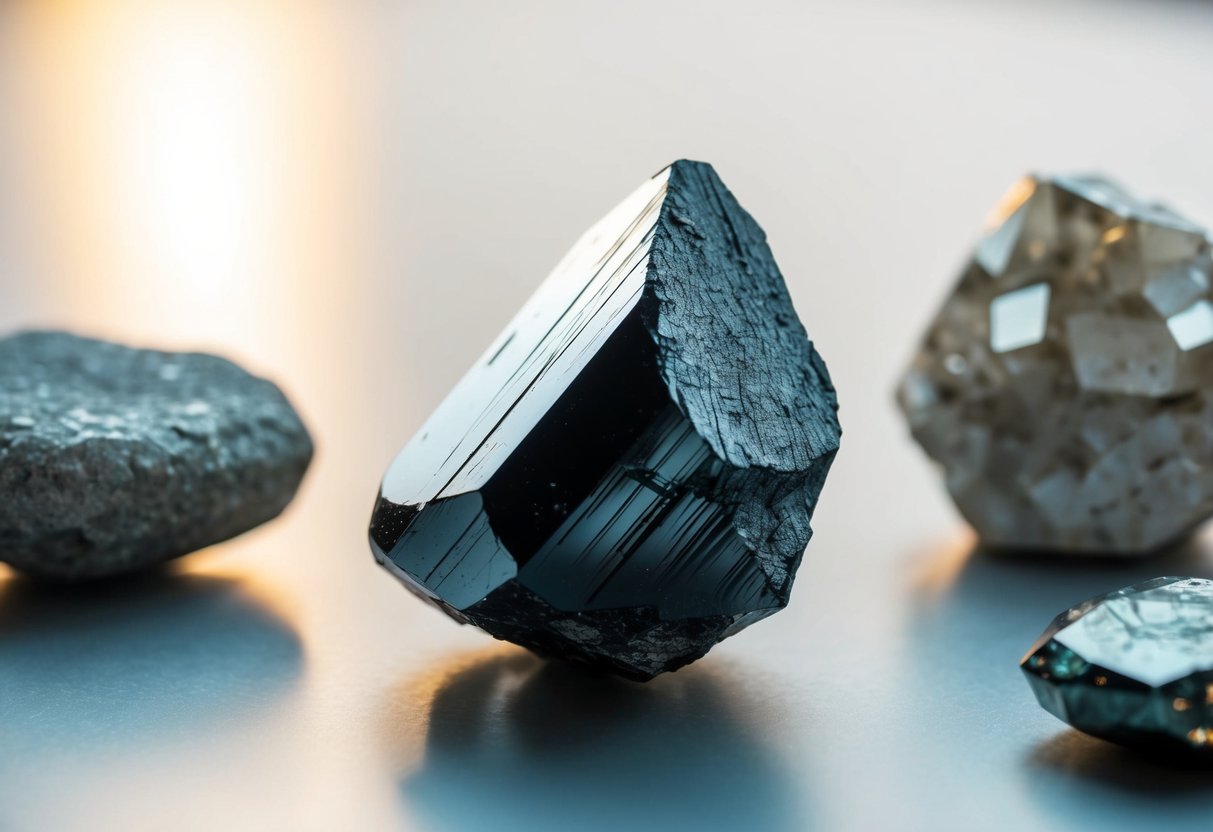
Hematite, with the chemical formula Fe₂O₃, is a form of iron oxide. It usually appears in a metallic grey color and has a shiny finish. Hematite is known for its ability to absorb negative energy and promote mental clarity.
This stone is commonly found in various places around the world, often in areas with rich iron deposits. It is classified as a metal oxide and serves as a primary ore for iron production.
Key properties include:
- Grounding: Regarded as a grounding stone, hematite allows you to feel balanced and stable.
- Energy Regulation: It effectively transforms negative energies into positive ones, which helps improve emotional well-being.
- Physical Benefits: Many believe it enhances circulation and can support kidney health.
Hematite in the World of Semiconductors
Did you know that hematite plays a role in the semiconductor industry? It is studied for its potential in electronic applications due to its semiconducting properties. Hematite shows promise due to its energy bandgap, which makes it suitable for devices such as solar cells.
In technical terms, hematite is often recognized as a p-type semiconductor. This means it can conduct electricity better when it is exposed to light or heat, making it a valuable material for energy-efficient applications.
Here’s a quick rundown of its uses:
- Solar Cells: It may improve efficiency in solar panels.
- Photodetectors: Used in light-sensing applications.
Hematite’s properties make it a topic of interest in research on sustainable energy solutions.
Spectral Signature: Understanding Hematite’s Bandgap
The bandgap of hematite is critical for its applications. The bandgap measures the energy difference between the valence band and the conduction band of electrons. For hematite, this bandgap is approximately 2.0 eV.
Knowing the bandgap helps scientists understand how hematite behaves under different conditions. A larger bandgap means it requires more energy to conduct electricity, which is essential for designing effective electronic and optoelectronic devices.
Soul Signal Quiz
What Message Is the Universe Sending You Right Now?
Take the 60-second Soul Signal Quiz and reveal whether this sign points to clarity, love, purpose, protection, or transformation.
Physical and Chemical Stability
Understanding the stability of hematite is crucial for its various applications. This section covers how surface charge and pH influence stability, as well as the environmental factors that play a role.
Interplay of Surface Charge and pH
Hematite’s stability is greatly affected by its surface charge, which is dependent on the pH of the surrounding environment. When the pH changes, the surface charge can become positive or negative. For example:
- At low pH: The surface of hematite carries a positive charge. This can lead to aggregation or clumping.
- At high pH: Hematite surfaces shift to a negative charge, which promotes better dispersion in solutions.
Controlling pH is essential in experiments involving hematite. A stable pH helps maintain the desired surface charge, ensuring effective performance in applications like catalysis and water treatment.
Factors Influencing Hematite Stability
Several environmental factors can influence hematite stability:
- Temperature: Higher temperatures can lead to increased instability, causing potential changes in structure.
- Ionic Strength: The presence of ions in a solution can affect the attraction or repulsion between hematite particles.
- Presence of Organic Matter: Organic compounds can interact with hematite, altering its stability in various environmental conditions.
Understanding these factors helps in designing better systems for using hematite in real-world applications. For instance, knowing that a higher ionic strength might hinder stability can guide engineers in optimizing processes for natural resource extraction or environmental cleanup.
Nanoparticles and Colloidal Behavior

When you dive into the world of nanoparticles, especially hematite, you start to see how size and environmental conditions affect their stability. Several factors, including aggregation and interactions between particles, play a crucial role in their behavior in various settings.
Defining Nanoparticle Size and Behavior
Nanoparticles are tiny particles, typically sized between 1 and 100 nanometers. Their small size gives them unique properties, such as increased surface area and reactivity. Hematite nanoparticles, for instance, can be measured at various sizes, like 12, 32, and 65 nanometers.
The size of these particles influences their behavior in a solution. Smaller nanoparticles often show higher kinetic stability and tend to remain dispersed longer than larger ones. You might wonder how size affects their application in environmental processes like sorption and dissolution—smaller sizes usually lead to better performance in those areas.
Hematite Aggregation and Dependent Factors
Hematite nanoparticles can aggregate, which means they stick together, forming larger clusters. This behavior is influenced by several factors such as pH, ionic strength, and concentration.
For example, studies show that at different pH levels (from 5 to 9), the aggregation behavior of hematite changes. At high ionic strength, the particles may clump together more quickly due to reduced electrostatic repulsion. Understanding these conditions helps predict how hematite will behave in real-world scenarios.
The Role of DLVO Theory in Colloidal Particles
The DLVO Theory helps explain the stability of colloidal particles, including nanoparticles. This theory combines two main forces: attractive van der Waals forces and repulsive electrostatic forces.
You can think of this like a tug-of-war. If the repulsive forces are stronger, nanoparticles remain separated and stable. Conversely, if the attractive forces win, aggregation occurs. DLVO theory helps scientists estimate the critical coagulation concentration (CCC), which is the minimum electrolyte concentration needed to cause significant aggregation.
Understanding these dynamics can aid in designing better applications for hematite nanoparticles in environmental remediation and other fields.
Hematite’s Interaction With Salts and Organic Matter

Hematite interacts closely with salts and organic matter, which affects its stability and behavior in various environments. Understanding these interactions can help you grasp the essential properties of hematite, especially regarding aggregation and transport.
Hematite and NaCl: A Case of Ionic Strength
When hematite is mixed with sodium chloride (NaCl), the ionic strength of the solution plays a significant role in its stability. Higher concentrations of NaCl can lead to increased aggregation of hematite particles.
- Critical Coagulation Concentration (CCC): This is the minimum electrolyte level that causes rapid particle clustering. As you add NaCl, the CCC decreases, leading to more aggregation.
- Effects of pH: Hematite stability varies with pH levels between 5-9. At different pH levels, particles behave differently, influenced by the presence of NaCl.
This aggregation can affect how hematite behaves in soil systems and its ability to transport nutrients and contaminants. Without careful management, these effects can alter soil chemistry.
Influence of Natural Organic Matter on Hematite Particles
Natural organic matter (NOM), including humic and fulvic acids, also impacts hematite’s stability. NOM can either stabilize or destabilize hematite particles based on its concentration and composition.
- Functional Groups: Humic acids contain functional groups that bind to the surface of hematite, reducing aggregation and enhancing stability.
- Dissolved Organic Matter (DOM): This refers to organic materials that dissolve in water. It plays a critical role in altering hematite properties in natural systems.
As conditions change, these interactions can affect nutrient availability and pollutant transport. Therefore, understanding how NOM interacts with hematite is key to managing soil and water quality effectively.
Hematite in Environmental Systems

Hematite plays an important role in how contaminants move and react in the environment. Its stability and unique properties help it interact with various substances, making it significant for environmental processes.
Transport and Agglomeration of Hematite
Hematite nanoparticles are influential in transporting contaminants. These particles can affect how pollutants move through soil and water systems. Their size, typically around 34.4 nm, impacts their ability to aggregate.
Key factors include:
- Ionic Strength: Higher ionic strength can lead to quicker aggregation, making hematite less available for transport.
- pH Levels: Changes in pH affect the surface charge of particles, influencing their stability and transport.
As hematite nanoparticles aggregate, they can form larger clusters. This agglomeration affects their overall behavior in environmental systems, particularly in soil.
Hematite’s Role in Heavy Metal Remediation
Did you know hematite can help clean up heavy metal pollutants? It’s known for its ability to adsorb metals, making it useful in remediation efforts.
Here’s how it helps:
- Adsorption Properties: Hematite has a high surface area, allowing it to attract and hold onto heavy metals like lead and cadmium.
- Chemical Reactions: It can also participate in reactions that transform harmful metals into less toxic forms.
In many studies, including those in regions like China, hematite has shown effectiveness in reducing heavy metal concentrations in contaminated sites. This makes it a strong candidate for enhancing soil health and water safety.
With its unique properties, hematite proves to be essential in managing environmental contaminants effectively.
Surface Engineering of Hematite Particles
Surface engineering is key to enhancing the properties of hematite particles, making them more suitable for a variety of applications. By modifying the surface characteristics, you can improve stability, reactivity, and overall performance.
Modifying Hematite for Industrial Uses
In industrial settings, surface modification of hematite can significantly boost its effectiveness. Techniques like coating hematite with materials such as yttrium oxide can enhance stability and performance.
-
Colloidal Hematite – When hematite is dispersed in a solution, it forms a colloidal suspension. This makes it easier to manipulate and incorporate into various applications.
-
Charge Control – Adjusting the surface charge of hematite affects its interaction with other materials. By managing the charge, you can improve metal transport and stability.
-
Phyllosilicates – These minerals can be used to modify hematite surfaces, providing enhanced physical and chemical properties that benefit specific uses.
Innovations in Hematite Surface Complexation
Recent research focuses on the surface complexation of hematite to improve its capabilities. Innovations in this area are promising for both environmental and industrial applications.
-
Surface Complexation Models – These models help predict how hematite interacts with different ions in solution. They play an essential role in understanding metal transport and adsorption processes.
-
Charge-Trapping Techniques – This method captures charges at the mineral surface, helping to stabilize reactive compounds. This is especially beneficial in catalytic processes.
-
Environmental Applications – Enhanced surface engineering of hematite is being explored for use in water treatment and pollutant cleanup, showcasing its versatility.
By focusing on these modifications, you can unlock the full potential of hematite particles, making them a valuable resource across multiple fields.
Applications and Future of Hematite
Hematite is not just a fascinating mineral; it plays a vital role in various applications and holds great potential for future advancements. Let’s explore two main areas where hematite could shine.
Hematite’s Potential in Water Splitting
Water splitting is a process that uses light to create hydrogen fuel. Hematite (α-Fe₂O₃) can be a strong contender in this area. It has a suitable bandgap for absorbing sunlight. Many researchers focus on enhancing its efficiency for water oxidation, a key reaction in clean energy production.
In studies, hematite has shown promise, but there’s room for improvement. It mainly suffers from low current density. Future efforts may focus on engineered nanoparticles with better dispersion. This could lead to increased surface area and improved light absorption. Brighter days could be ahead for sustainable energy!
Nanotechnological Advances with Hematite
Nanotechnology is unlocking new possibilities for hematite. By creating nanoparticulate iron oxide minerals, scientists can enhance its physical and chemical properties. These engineered polymeric nanoparticles can be tailored to specific uses, making hematite more versatile.
For example, in the soft matter field, hematite’s properties are highly valued. Its unique surface chemistry allows for applications in sensors and catalysts. Researchers are eager to develop new composites that maximize these benefits. The future is looking bright as we explore innovative uses for this abundant and stable mineral!
Frequently Asked Questions
Hematite is a fascinating stone with many unique properties. Below are some common questions about how hematite can influence strength, stability, and well-being in your life.
What are the spiritual benefits of wearing a hematite bracelet?
Wearing a hematite bracelet is thought to promote grounding and protection. Many believe it helps transform negative energies into positive ones. You might also find that it boosts your confidence and keeps you feeling balanced throughout the day.
How can hematite influence one’s stability and strength astrologically?
In astrology, hematite is often linked to the root chakra. This connection is said to enhance your sense of security and stability. If you are looking for strength in difficult times, wearing or holding hematite might give you the support you need.
In what ways might hematite contribute to emotional or physical healing?
Hematite is known for its potential healing properties. People often use it to promote mental clarity and emotional well-being. Physically, it is believed to support circulation and bolster strength and endurance during physical activities.
Could you tell me about the durability of hematite stone in jewelry?
Hematite is quite durable, making it suitable for everyday wear in jewelry. However, it can scratch easily due to its metallic luster. It’s best to store hematite jewelry separately to avoid damage from other harder stones.
Are there any specific astrological benefits associated with hematite?
Yes, hematite is generally associated with grounding energies. Astrologically, it can help during times of anxiety or stress. Those under Earth signs often find hematite particularly beneficial for enhancing their natural strengths.
How might hematite crystal be incorporated into daily life for its believed benefits?
You can incorporate hematite into your daily life in several ways. Carrying a small piece in your pocket can help keep energies balanced. Additionally, you can also place it in your workspace or wear jewelry to benefit from its grounding properties throughout the day.
Your reading does not have to end here
Keep exploring your path
Try a free tool or continue into related meanings while the curiosity is still warm.
